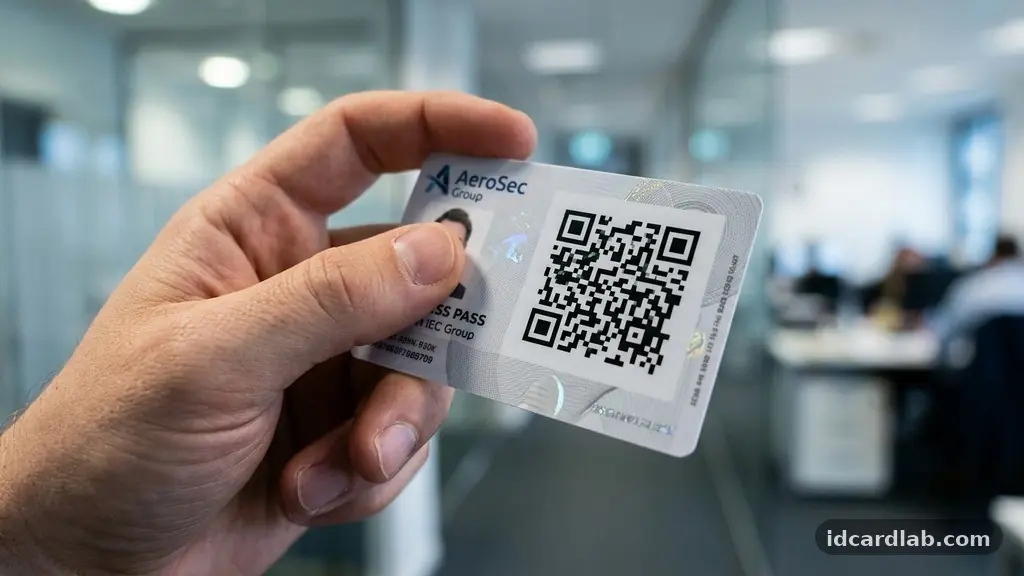
Integrating QR Codes on ID Cards offers a bridge between physical identity and digital verification. Organizations increasingly rely on these two-dimensional symbols to streamline check-ins, manage access, and store supplementary information that exceeds the space on a plastic badge. By embedding encoded data directly onto a physical credential, administrators can facilitate faster interactions while reducing manual entry errors.
This technology provides a cost-effective alternative to more complex RFID or NFC systems for many mid-sized operations. Understanding how to balance these functional gains with necessary privacy safeguards is essential for any modern security strategy. This article examines the practical applications, operational benefits, and inherent limitations of using these codes in professional environments.
Core Functionality and Technical Standards
At their simplest, QR codes act as high-capacity containers for text, URLs, or contact information. When printed on an ID card, they follow the ISO/IEC 18004 technical standard, which defines the matrix symbology and error correction levels.
High error correction allows a code to remain readable even if the card surface suffers minor scratches or smudges. This durability is vital for badges that undergo daily wear and tear in active work environments.
The data capacity of a QR code is significantly higher than that of traditional linear barcodes. While a standard barcode might only hold a numeric employee ID, a QR code can store a full vCard, a unique URL, or a cryptographic signature.
This versatility allows organizations to trigger specific actions, such as opening a secure portal or initiating a visitor management sequence, with a single scan. Because they are readable by any standard smartphone camera, they remove the need for proprietary hardware at every entry point.
Streamlining Access Control Systems
Many facilities utilize QR codes to supplement existing access control systems rather than replace them. In high-security zones, a badge might contain both an RFID chip for proximity sensing and a printed QR code for secondary verification.
This dual-layer approach provides a form of multi-factor authentication, ensuring that the person holding the card is authorized to be in that specific area. When a guard or reader scans the code, the system can instantly display a digital profile to confirm identity.
This method is particularly effective for temporary personnel or contractors who do not require long-term RFID provisioning. Generating a temporary QR code is significantly faster and cheaper than programming a physical smart card.
Once the contract period ends, the administrator simply revokes the digital permissions associated with that specific code. The physical card remains a passive object, but the digital link to the secure network is severed instantly.
Visitor Management and Temporary Credentials
Visitor management software has transformed how lobbies handle foot traffic, often leveraging QR codes for efficiency. When a visitor registers online, the system generates a unique, time-sensitive code sent to their email or mobile device.
Upon arrival, the visitor shows this code to a kiosk or a staff member, who prints an ID badge with the code embedded. This process ensures that the visitor’s information is pre-validated, reducing wait times and clerical errors at the front desk.
These codes can also track a visitor’s location within a facility for safety purposes. If an emergency occurs, security personnel can scan the badges of visitors present in a building to generate an accurate muster list.
This level of tracking is invaluable for compliance with fire safety regulations and physical security protocols. By moving from paper logs to digital scanning, organizations gain a clear, timestamped record of who entered the premises and when they departed.
Data Privacy and Security Considerations
Storing information directly on a physical card creates unique challenges for data privacy compliance. If a QR code contains sensitive personal information in plain text, anyone who scans the card can view that data.
To adhere to regulations like the GDPR, organizations must use encrypted data storage or store only a unique identifier in the code. The actual personal details should reside on a secure server, accessible only to authorized scanners after a handshake protocol.
| Data Strategy | Security Level | Implementation Cost |
|---|---|---|
| Plain Text URL | Low | Minimal |
| Encrypted Identifier | High | Moderate |
| Biometric Link | Very High | Significant |
Organizations must also consider the risk of “code cloning” or physical duplication. Because a QR code is simply a visual pattern, a high-resolution photograph of an ID card can be used to replicate the code on another device.
For sensitive areas, relying solely on the code is insufficient. It should always be paired with a visual check of the cardholder’s face or an additional layer of biometric authentication to confirm the match.
Operational Benefits for Personnel Tracking
Using QR codes for personnel tracking simplifies attendance and task management across large sites. Warehouse managers, for example, can scan an employee’s ID to log the start of a shift or assign specific equipment to that individual.
This creates a granular audit trail that is much harder to achieve with manual sign-in sheets. The system automatically updates the central database, providing managers with real-time insights into workforce availability.
- Instant verification of certifications and training status.
- Rapid deployment of temporary staff without issuing new hardware.
- Reduced reliance on expensive, proprietary badge readers.
- Simplified integration with mobile-based time tracking applications.
- Improved accuracy in health and safety compliance reporting.
This digitization of personnel records also helps in managing large-scale events or construction sites. Supervisors can quickly verify that everyone on-site has the required safety training by scanning their badge.
If a certification is expired, the system can flag the user, preventing them from entering high-risk zones. This proactive approach to safety minimizes human error and ensures that only qualified individuals handle sensitive equipment.
Limitations and Physical Durability
Despite their utility, QR codes are not immune to environmental factors that affect readability. Direct sunlight, extreme glare, or deep scratches on the protective laminate can cause scanning failures.
While error correction helps, it has physical limits; if a significant portion of the code is obscured, the reader will not function. This makes QR codes less reliable than contactless chips for heavy-duty industrial environments where badges are frequently dropped or exposed to chemicals.
Another limitation is the “offline verification” problem. If the scanning device is not connected to the central server, it may not be able to decrypt the data or verify the status of the ID.
This requires either a cached database on the device or a robust wireless network coverage across the entire facility. For remote locations or areas with poor connectivity, the lack of real-time server access can render the QR code system effectively useless for security purposes.
Integrating vCard Functionality
For networking and professional ID cards, vCard integration is a common and highly functional application. By encoding contact details into a QR code, an employee can allow others to save their information directly to a phone’s address book.
This reduces the need for physical business cards and ensures that contact information remains up-to-date. If a phone number or email address changes, the administrator updates the server-side record, and the code immediately reflects the new information.
This feature is particularly useful for sales teams and client-facing roles where exchanging contact details is frequent. It removes the friction of manual data entry, which is prone to typos and often results in lost leads.
Furthermore, it allows for richer data, such as LinkedIn profiles, portfolio links, or direct appointment booking URLs. This transforms a standard ID card from a passive security tool into an active professional networking asset.
Future Trends in Digital Credentialing
The evolution of QR codes on ID cards is moving toward more dynamic, rotating patterns that change every few seconds. These “dynamic codes” prevent the risk of unauthorized duplication, as a static photo of the code becomes useless almost immediately.
This technology mirrors the security found in modern banking apps, providing a high level of assurance for sensitive access points. As smartphone processing power increases, these complex cryptographic challenges can be handled by standard devices without any latency.
Another emerging trend is the integration of digital credentialing with mobile wallets. Instead of relying on a physical plastic card, many organizations are shifting toward virtual IDs stored in Apple Wallet or Google Wallet.
The QR code on the physical card serves as a backup or a transitionary tool for those not yet ready for a fully mobile-first environment. This hybrid approach ensures that security protocols remain functional across a diverse workforce with varying levels of technological comfort.
Frequently Asked Questions
Can a QR code be hacked or spoofed?
Yes, any visual code can be photographed and replicated. To mitigate this, organizations should treat the QR code as only one part of a multi-layered security strategy, rather than the primary credential.
Are QR codes better than RFID for access control?
They are not necessarily better, but they are often more versatile and cheaper to deploy. RFID is superior for high-throughput, hands-free entry, while QR codes excel at data-rich interactions like visitor management and identity verification.
Do I need expensive software to use these codes?
Not necessarily, as many open-source libraries exist to generate and read standard QR codes. However, for enterprise-grade security and data management, dedicated visitor management software is recommended to ensure data privacy compliance.
How long do these codes last on a badge?
With high-quality thermal printing and a protective laminate, a QR code can last the entire lifespan of the ID card. The main risks are physical abrasion and fading caused by UV light exposure over several years.
Can I use a standard smartphone for verification?
Yes, modern smartphone cameras are highly effective at reading QR codes. This makes them an excellent choice for distributed workforces where specialized hardware scanners are not available or practical to carry.
Conclusion
Implementing QR codes on ID cards provides a practical, scalable, and cost-efficient method for managing identity and security. By balancing the ease of digital credentialing with robust encryption and physical security protocols, organizations can improve their operational efficiency while maintaining strict data privacy. Whether you are managing a small office or a large industrial site, these codes offer a flexible solution that can grow with your needs.
The key to success lies in choosing the right balance between convenience and security. As you integrate these systems, prioritize data encryption and ensure that scanning hardware is reliable enough for your specific environment.
If you are ready to modernize your identification process, start by auditing your current visitor and employee tracking needs to see where a well-placed code can remove friction. Feel free to reach out to security experts or software providers to discuss how these tools can fit your specific infrastructure.